Crab Island Water Sports, LLC v. Discount Watersports, Inc. d/b/a Happy’s Crab Island Watersports, et al., No. 3:25-cv-01296-MCR-ZCB (N.D. Fla., Pensacola Division), was a fight between two Emerald Coast pontoon-rental companies over the name of a famous sandbar. Crab Island Water Sports, a Fort Walton Beach operator, sued its Destin competitor and the competitor’s two principals on August 8, 2025. It claimed that “Happy’s Crab Island Watersports” infringed its unregistered mark CRAB ISLAND WATERSPORTS.
The case never reached a ruling. The defendants moved to dismiss on the ground that the name is a place plus a generic word. The plaintiff opposed. The defendants then asked for leave to file a reply, and the plaintiff opposed that request the same day. Six weeks later, 91 days after the complaint was filed, the parties announced a settlement, and Judge M. Casey Rodgers closed the case on November 21, 2025, 105 days after filing.
This post draws on the complaint, the motion to dismiss, the plaintiff’s opposition to the request to reply, the initial scheduling order, the joint notice of settlement, the dismissal order and the full docket. It ends with five recommendations drawn from the motion practice and the speed of the resolution.
The parties, the place, and the marks
Crab Island is not an island. It is a submerged sandbar in Choctawhatchee Bay near Destin, where boaters anchor to swim and socialize. Dozens of local operators sell pontoon rentals, cruises, and shuttles to it, and many use “Crab Island” in their names.
The plaintiff, Crab Island Water Sports, LLC, does business as Crab Island Watersports andCrab Daddy’s Pontoons. It rents pontoon boats and jet skis from Brooks Bridge Marina on Okaloosa Island in Fort Walton Beach. Its corporate disclosure statement identifies its parent as Pontoon Destin Watersports, LLC, and the complaint explains that the company’s “new owner” brought the suit to protect the name.
The defendants were Discount Watersports, Inc., based at 316 Harbor Boulevard in Destin, which operates as Happy’s Crab Island Watersports, and its principals Jeff Hassman and Chuck Highers. Discount registered the Florida fictitious name “Happy’s Crab Island Watersports” (Reg. No. G21000168543) on December 20, 2021, and launched happyswatersports.com in 2022.
A crowded field of “Crab Island” marks
We found no federal registration or application for CRAB ISLAND WATERSPORTS. The USPTO record does show several other “Crab Island” marks held by unrelated businesses:
| Mark | Status | Services | Note |
|---|---|---|---|
| CRAB ISLAND WATER TAXI | Reg. No. 5,759,682 (2019) | Water taxi services | “WATER TAXI” disclaimed |
| CRAB ISLAND SHUTTLE BOATS / CRAB ISLAND EXPRESS | Applications filed 2019–2020 | Water taxi services, boat tours | One earlier filing abandoned |
| CRABISLAND.COM | Application filed 2022 | Website about recreational activities at Crab Island | Uses the place name descriptively |
| CRAB ISLAND (word mark) | Reg. No. 3,971,671 | Clothing | Different goods |
| CRAB ISLAND (design) | Reg. No. 5,798,857 | Seafood restaurants | Different services |
That landscape matters. When many businesses use the same place name for related services, each one’s rights in that name are narrow. The USPTO has also taken a position on the place name itself: it refused to register CRAB ISLAND (Serial No. 88/001,420) for advertising services as primarily geographically descriptive, citing tourism and news sources describing Crab Island as a Destin attraction. The defendants attached that Office Action to their motion to dismiss.
The case at a glance
| Case | Crab Island Water Sports, LLC a/k/a Crab Island Watersports v. Discount Watersports, Inc. d/b/a Happy’s Crab Island Watersports, Jeff Hassman and Chuck Highers |
| Case number | 3:25-cv-01296-MCR-ZCB |
| Court | U.S. District Court, Northern District of Florida, Pensacola Division |
| Judges | District Judge M. Casey Rodgers; Magistrate Judge Zachary C. Bolitho |
| Filed | August 8, 2025 |
| Jury demand | None |
| Outcome | Settled; dismissed from the active docket November 21, 2025, with 60 days to reopen if the settlement was not consummated |
| Motion to dismiss | Fully briefed but never decided |
What the complaint alleged
The complaint told a simple story. Crab Island Water Sports began operating in 2015 (and its predecessor “likely as far back as 2009”) under CRAB ISLAND WATERSPORTS, promoted the name on its website, travel sites and social media, and built goodwill. In 2022, Discount launched a website prominently branded HAPPY’S CRAB ISLAND WATERSPORTS. The plaintiff alleged that it “immediately began to see confusion,” and that the branding was intentional because the pages linked from the landing page used a different brand, HAPPY LIFE, for dinner, sunset, murder-mystery and adult cruises. It also objected that the adult cruises clashed with its family image.
Two background facts stand out. The plaintiff had sued over the same name in Okaloosa County circuit court in 2022 (Case No. 2022CA001349 F), and that case was dismissed for lack of prosecution. And although no federal registration was alleged, the complaint repeatedly called the defendants’ mark a “counterfeit.”
| Count | Claim | Against |
|---|---|---|
| I | Federal unfair competition and false designation of origin, 15 U.S.C. § 1125(a) | All defendants |
| II | Florida common-law trademark infringement | All defendants |
| III | Florida common-law unfair competition | All defendants |
| IV | Cancellation of the fictitious name “Happy’s Crab Island Watersports” (Reg. No. G21000168543) | Discount |
The requested injunction was broad. It would have barred the defendants from using any mark containing “CRAB” or “CRAB ISLAND” for transportation, tourism or watercraft rental, and from registering any domain containing those words. The complaint also sought profits and damages (enhanced or trebled), destruction of materials, cancellation of the fictitious name, and attorney’s fees under § 1117. It alleged that Hassman and Highers personally directed and profited from the infringement.
The motion to dismiss
On September 8, 2025, the day their response was due, the defendants filed a 6,110-word Rule 12(b)(6) motion (ECF No. 13). Its core argument: every count requires an enforceable mark, and the complaint pleaded none.
- “Watersports” is generic. Relying on Miller’s Ale House v. Boynton Carolina Ale House, 702 F.3d 1312 (11th Cir. 2012), and USPTO v. Booking.com, 591 U.S. 549 (2020), the motion cited dictionary definitions of “watersport” and the plaintiff’s own exhibits describing itself as a “full-service watersports company” offering boating, jet skiing and snorkeling.
- “Crab Island” is geographically descriptive. The motion quoted the plaintiff’s website (“pull up to the Crab Island sandbar”), asked the court to take judicial notice of Crab Island’s location, and attached the USPTO’s refusal of CRAB ISLAND as geographically descriptive. It compared the case to Bavaro Palace (beach name plus “palace”) and Casey Key Resort, LLC v. CK Resorts JV, LLC (M.D. Fla. 2021), where a place-plus-generic-term mark was dismissed at the pleading stage.
- Secondary meaning was not plausibly pleaded. Under Tropic Ocean Airways, Inc. v. Floyd, 598 F. App’x 608 (11th Cir. 2014), conclusory allegations that a mark “acquired distinctiveness” do not count. Stripped of those, the complaint alleged only use since 2015 and self-promotion on the plaintiff’s own website and social media. It did not allege a single day of exclusive use, and it did not allege that secondary meaning existed before the defendants’ 2022 adoption.
- No plausible likelihood of confusion. The motion argued that the shared words are generic or descriptive and that the distinctive part of the defendants’ mark is HAPPY’S, an arbitrary house mark. It laid the marks side by side as who / where / what: HAPPY’S / CRAB ISLAND / WATERSPORTS versus — / CRAB ISLAND / WATERSPORTS. It also pointed out that the plaintiff’s own marketing contrasted its Okaloosa Island location with the “congestion and dangers of the Destin Harbor,” where Happy’s operates. The allegations of actual confusion and bad intent were called conclusory.
- Count IV is not a cause of action. Florida’s Fictitious Name Act, Fla. Stat. § 865.09, provides no private claim for cancellation. A court can order a defendant to stop using or cancel a fictitious name, but only as a remedy for proven infringement.
The motion sought dismissal with prejudice and attorney’s fees.
The opposition and the fight over a reply
The plaintiff filed its opposition on September 22 (ECF No. 15), attaching two exhibits, including a USPTO printout of registrations containing WATERSPORTS. The opposition itself is not among the documents reviewed for this update. The plaintiff’s later filing describes its two main points: the complaint pleaded secondary meaning through more than ten years of continuous and substantially exclusive use, and “watersports” is not generic, as shown by the many registrations that include it.
On September 25, the defendants moved for leave to file a reply (ECF No. 17). They wanted to answer the secondary-meaning argument by pointing to other “Crab Island” users, and to argue that the registrations in the plaintiff’s exhibit disclaimed WATERSPORTS, showing it is at least descriptive.
The plaintiff responded the same day with a short opposition of 839 words (ECF No. 18). It relied on Local Rule 7.1(I), under which replies are not permitted without leave, and on Judge Rodgers’ own decisions requiring “extraordinary circumstances” (Greene v. Ascend Performance Materials, Inc., N.D. Fla. 2024; Powell v. Southern-Owners Ins. Co., N.D. Fla. 2018). It argued that the reply would add nothing on third-party users and would raise a new argument, shifting from “generic” to “descriptive,” that the plaintiff had no chance to answer. The court never ruled on the request.
Docket timeline
| Date | Event |
|---|---|
| Aug 8, 2025 | Complaint filed (ECF No. 1), with Exhibits A–L |
| Aug 11, 2025 | Clerk directs the plaintiff to re-file the civil cover sheet as a separate document; USPTO notified of the suit |
| Aug 18, 2025 | All three defendants served; responses due September 8 |
| Sep 8, 2025 | Defense counsel appear; motion to dismiss filed (ECF No. 13) |
| Sep 11, 2025 | Initial Scheduling Order (ECF No. 14): disclosure statements due Sept. 25; Rule 26(f) report due Oct. 27; discovery due March 9, 2026 |
| Sep 22, 2025 | Plaintiff’s opposition to the motion (ECF No. 15); defendant’s disclosure statement |
| Sep 25, 2025 | Defendants’ motion for leave to reply (ECF No. 17); plaintiff’s same-day opposition (ECF No. 18) |
| Oct 2, 2025 | Clerk flags the plaintiff’s missed disclosure deadline; plaintiff files its statement the same day, naming Pontoon Destin Watersports, LLC as parent |
| Oct 16, 2025 | Joint report of the parties’ planning meeting |
| Nov 7, 2025 | Joint notice of settlement: agreement in principle resolving all claims, defenses and counterclaims that were or could have been brought; parties ask for a stay and 20 days to finalize |
| Nov 21, 2025 | Order dismissing the case from the active docket, with 60 days to reopen on good cause; case closed |
Five key recommendations
1. Plead secondary meaning with facts, not labels
The motion’s strongest point was that the complaint said the mark had “acquired distinctiveness” without facts to back it up. Under Tropic Ocean, a court strips those conclusions away and asks what is left. A plaintiff with an unregistered, place-based mark should plead the four Conagra factors with specifics: years of use and how the name appears; advertising spend and where it ran; efforts to tie the name to the company; and, most important, evidence that the public actually links the name to it, such as press coverage, reviews and misdirected calls or bookings. The plaintiff’s opposition leaned on more than ten years of use and the five-year rule for acquired distinctiveness. But that five-year rule comes from the USPTO’s registration practice (15 U.S.C. § 1052(f)). It is not a presumption a court must apply in an infringement case, and length of use alone rarely proves secondary meaning. Gather that evidence before filing and plead that secondary meaning existed before the defendant started using the name, here before 2022.
2. Your own exhibits are part of the complaint, so audit them
Under Rule 10(c), exhibits are part of the pleading, and the defendants used the plaintiff’s twelve exhibits against it. The website invited customers to “pull up to the Crab Island sandbar,” which made the place name descriptive. Its self-description as a “full-service watersports company” made the second word generic. Its marketing set its Okaloosa Island location against the “congested” Destin Harbor, which cut against confusion. Its screenshot of the defendants’ logo showed HAPPY’S dominating. Before attaching marketing materials, read them as defense counsel will. Likewise, avoid overstatement: calling an unregistered mark “counterfeited” invites the response that counterfeiting remedies require a registered mark, and a demand to bar any use of the word “CRAB” makes the plaintiff look like it is claiming a monopoly on a place name.
3. For defendants, an early, focused motion on distinctiveness creates leverage
The defense motion was filed on the response deadline and focused on the one element every count shared: an enforceable mark. It used evidence a court can consider at the pleading stage, including the plaintiff’s own exhibits, dictionary definitions, a request for judicial notice of geography, and a USPTO Office Action refusing CRAB ISLAND as geographically descriptive. It also used memorable framing (the who/where/what chart) and asked for dismissal with prejudice and fees. Within two months of that motion, the case was settled. Florida businesses sued over place names or industry words should look first at whether the plaintiff has pleaded a protectable mark at all, check the USPTO record for refusals of similar terms, and document third-party users early. Even if the motion is not granted, it frames the case for settlement.
4. In the Northern District, put everything in the first brief
Local Rule 7.1(I) does not allow a reply without leave, and Judge Rodgers has required “extraordinary circumstances.” The defendants’ request to reply gave the plaintiff a chance to argue, in a short same-day filing, that the reply would be an unfair new argument. Movants should anticipate the obvious responses in the opening brief. Here, that meant addressing third-party “Crab Island” users and the possibility that WATERSPORTS is descriptive rather than generic. Opponents should answer a request to reply quickly and briefly, framing any new argument as prejudicial. A related lesson for plaintiffs: evidence offered to show a word is not generic, such as registrations containing WATERSPORTS, can show it is descriptive if those registrants disclaimed the word.
5. Discovery does not wait, so use the early window to settle, and paper it carefully
Judge Rodgers issued the Initial Scheduling Order three days after the motion to dismiss was filed. Discovery proceeded while the motion was pending, with a cutoff of March 9, 2026, just before the spring and summer season. That schedule raised the cost of continuing, and the parties settled within weeks of their Rule 26(f) report. Both sides should plan for discovery and expense from the start rather than waiting for a ruling. When a case settles, remember that a dismissal order like this one lets a party reopen only within 60 days. A federal court generally has no power to enforce a settlement afterward unless it expressly retains jurisdiction or incorporates the agreement’s terms (Kokkonen v. Guardian Life Ins. Co., 511 U.S. 375 (1994)). If the deal requires future conduct, such as a rebrand, a coexistence arrangement or limits on ad keywords, ask for a consent judgment or an order retaining jurisdiction, and set out the obligations in detail.
Other lessons from the case
- Delay and earlier litigation have consequences. The plaintiff’s 2022 state-court suit was dismissed for lack of prosecution, and the defendants argued that the plaintiff had acquiesced in their use for three years. Brand owners who start an enforcement effort should finish it or reserve their rights in writing.
- Descriptive fair use is a strong shield in place-name cases. Even when a plaintiff proves secondary meaning, 15 U.S.C. § 1115(b)(4) protects good-faith use of a term to describe one’s own services. Pairing the place name with a distinctive house brand, as Happy’s did, strengthens that defense.
- Principals can be named personally. The complaint named the two individuals who allegedly directed the infringement. In the Eleventh Circuit, officers who actively direct infringing conduct can be personally liable, so owners should tender trademark complaints to their insurer promptly and check for advertising-injury coverage.
- Fictitious-name filings are not trademark rights, and cancelling one is not a separate claim. A Florida fictitious-name registration gives no trademark rights, but it is also not a cause of action to attack. Plaintiffs should request cancellation as part of the injunction, not as a separate count.
- Small filing details matter. The clerk flagged the civil cover sheet on day three and the plaintiff’s corporate disclosure statement after the deadline passed. The Northern District watches form closely.
What Florida courts have said about geographic marks
Florida state and federal courts apply the same basic rule. A place name used to describe where goods or services come from or are offered is descriptive. It is protected only with proof of secondary meaning, and courts demand a high degree of proof. Florida courts treat state-law trademark and unfair-competition claims the same way as Lanham Act claims, so the rule holds in state court too.
| Case | Court | Mark | What the court held | Lesson for place-name marks |
|---|---|---|---|---|
| Investacorp, Inc. v. Arabian Inv. Banking Corp., 931 F.2d 1519 (11th Cir. 1991) | 11th Cir. | INVESTACORP | A plaintiff bears “a high degree of proof” to establish secondary meaning for a descriptive term | The baseline standard Florida federal courts apply to every descriptive mark, geographic ones included |
| Bavaro Palace, S.A. v. Vacation Tours, Inc., No. 05-14824 (11th Cir. Oct. 2, 2006) (unpublished) | 11th Cir., from S.D. Fla. | BAVARO PALACE (hotel on Bavaro Beach, Dominican Republic) | A beach name plus the industry term “palace” is merely descriptive. No secondary meaning, because the hotel was always marketed as “Barceló Bavaro Palace.” Lanham Act and cybersquatting claims failed; the FDUTPA claim was remanded | Courts protect the name you actually use in the market. A place name stripped of your house brand may be unprotectable |
| Anderson v. Upper Keys Business Group, Inc., 61 So. 3d 1162 (Fla. 3d DCA 2011) | Fla. 3d DCA | CONCH REPUBLIC INDEPENDENCE CELEBRATION (Keys festival since 1990) | Reversed a ruling that the name was generic. It is descriptive, both of the event’s purpose and of its location, the Florida Keys, and may be protected if the owner proves secondary meaning on remand | Even a satirical or nickname-style place name is descriptive, not generic. The trial court also found that events 70 to 80 miles apart served separate markets |
| Gulf Coast Commercial Corp. v. Gordon River Hotel Assocs., 2006 WL 1382072 (M.D. Fla. May 18, 2006) | M.D. Fla. | (Naples-area hotel dispute) | Cited for the rule that descriptive or geographically descriptive marks require a high degree of proof of secondary meaning | Confirms the heightened burden at the trial-court level |
| Florida Virtual School v. K12 Inc., No. 6:20-cv-2354 (M.D. Fla. May 30, 2023) | M.D. Fla. | FLORIDA VIRTUAL SCHOOL / FLVS | The USPTO first refused FLORIDA VIRTUAL SCHOOL as geographic and merely descriptive, then registered it under § 2(f) on a showing of acquired distinctiveness. The court let the competitor’s counterclaim proceed, alleging fraud in that § 2(f) showing | A registration won through acquired distinctiveness is only as strong as the evidence behind it. Fraud claims can reach even incontestable registrations |
| MGFB Properties, Inc. v. ViacomCBS, Inc., No. 5:19-cv-00257 (N.D. Fla. 2021), aff’d (11th Cir. 2022) | N.D. Fla. / 11th Cir. | FLORA-BAMA (bar on the Florida–Alabama line; registered 2013) | The mark was treated as strong, but the title MTV FLORIBAMA SHORE was protected expressive use under the Rogers test, affirmed on appeal | A coined blend of place names can become a strong mark, but others may still use the geography to describe their own expressive works |
| FCC Hotel Tower, LLC v. Drummond, No. 2:23-cv-00702 (M.D. Fla., jury verdict Aug. 2026) | M.D. Fla. | MARCO BEACH OCEAN RESORT name and crest | A jury found that a condo owner’s rental businesses did not infringe the resort’s name or crest logo and did not compete unfairly | Owners of place-named properties face real limits when others accurately describe the same location; the jury’s specific reasoning is not public |
Where geographic marks fall on the strength spectrum
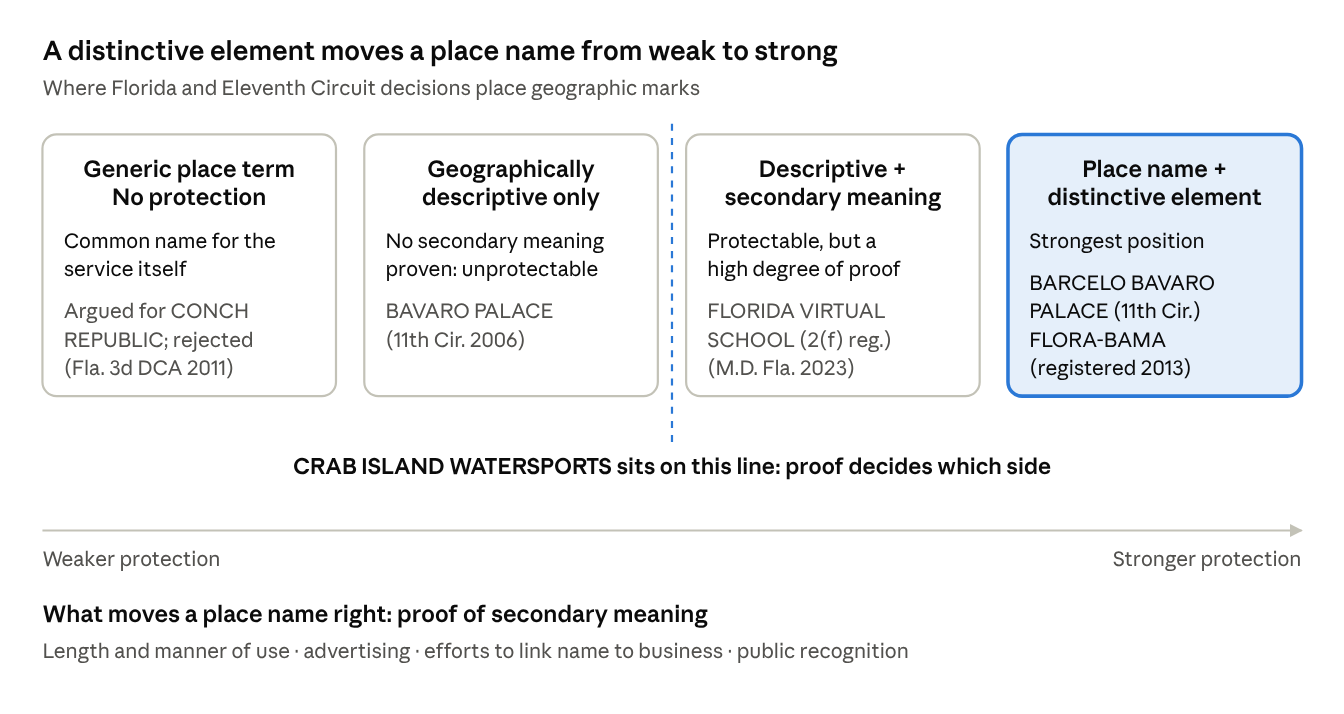
The Bottom Line
A bare place name sits at the weak end. It becomes protectable only with strong proof of secondary meaning, and it is strongest when paired with a distinctive house brand or coined element. The motion to dismiss in this case targeted exactly that weakness: it argued that CRAB ISLAND WATERSPORTS was a place plus a generic word, with no facts showing customers linked it to one company. The four secondary-meaning factors at the bottom come from the Eleventh Circuit’s Conagra test, which Florida’s Third District applied in Anderson.
Contract our team of Florida Trademark Attorneys today at [email protected] or call 305-374-8303 to address how we can assist you in defending trademark lawsuits in Pensacola, Tallahassee and/or Panama City.
This article is general information, not legal advice, and may not reflect the most recent legal developments. Reading it or contacting us does not create an attorney-client relationship. The hiring of a lawyer is an important decision that should not be based solely upon advertisements.