For the first time in the history of the Controlled Substances Act, some marijuana is no longer a Schedule I drug, and that opens a narrow but real door at the U.S. Patent and Trademark Office. Since April 2026, marijuana sold under a qualifying state medical license sits in Schedule III. Adult-use (recreational) marijuana does not. For cannabis brand owners, the result is a split landscape: a credible new argument for federal registration of medical marijuana marks, continued refusals for recreational products, and a hemp market about to be redrawn on November 12, 2026.
This article explains what changed, what the USPTO is likely to do with it, where recreational cannabis brands can still obtain state trademark registrations, and ten strategies we recommend for building a federal trademark portfolio around a cannabis brand.
Key takeaways:
- Only FDA-approved marijuana drug products and marijuana subject to a state medical marijuana license were moved to Schedule III. Recreational marijuana remains in Schedule I.
- The USPTO has not yet issued new examination guidance for Schedule III marijuana. Examination Guide 1-19 (2019) still governs, and applications are being filed as test cases.
- Recreational cannabis marks can still be registered in many adult-use states through the Secretary of State or equivalent office, but only for in-state use.
- Florida remains a medical-only state. Its 2026 adult-use ballot initiative did not qualify.
- A layered strategy (ancillary federal filings, careful identifications, state registrations and documented common-law use) is still the most reliable way to protect a cannabis brand.
What the 2026 Rescheduling Actually Did
The April 2026 order moved two categories of marijuana to Schedule III and left everything else in Schedule I. On April 22, 2026, Acting Attorney General Todd Blanche signed a final order, published in the Federal Register on April 28, 2026. It followed President Trump’s December 18, 2025 executive order directing the Department of Justice to expedite rescheduling.
| Category | Schedule after April 2026 | Trademark significance |
|---|---|---|
| FDA-approved drug products containing marijuana-derived THC | Schedule III | Registrable in principle, subject to FDA approval and DEA registration |
| Marijuana subject to a qualifying state medical marijuana license | Schedule III | New argument for federally lawful use, subject to DEA registration |
| Adult-use (recreational) marijuana, even under a state program | Schedule I | Still refused by the USPTO |
| Unlicensed or bulk marijuana and extracts | Schedule I | Still refused |
| Synthetically derived THC | Schedule I | Still refused |
| Hemp (as statutorily defined) | Not controlled | Registrable, subject to FDCA limits and the November 12, 2026 redefinition |
The order also creates an expedited DEA registration pathway for state medical licensees and keeps Schedule I-style controls such as import and export permits. Several commentators note it relieves medical licensees of the Section 280E tax deduction bar. The order is being challenged in the D.C. Circuit as an unauthorized “hybrid” scheduling approach, so its durability is not guaranteed.
Broader rescheduling is still pending and currently stayed. DEA held a hearing on rescheduling all marijuana, including adult-use, from June 29 to July 15, 2026, and post-hearing briefs closed the record on August 17. On September 29, 2026, Chief Administrative Law Judge Derek Julius stayed the proceeding to consider whether to admit a September 23 GAO report on drug-scheduling procedures. Rescheduling opponents have since moved to reopen the hearing, with responses due October 21, 2026. After the ALJ’s recommendation, parties may file exceptions and the DEA Administrator decides. No date is set.
For brand owners, the practical point is simple: until a final rule covers adult-use marijuana, recreational cannabis goods and dispensary services remain federally unlawful for trademark purposes.
What the USPTO May Now Allow
The USPTO has not changed its written rules yet, but Schedule III gives state-licensed medical marijuana operators their first credible argument for federal registration. Federal registration requires lawful use in commerce under federal law (TMEP §907). Under Examination Guide 1-19, issued May 2, 2019, the Office refuses marks whose goods or services clearly violate federal law, regardless of state legality, and checks the Controlled Substances Act, the Food, Drug and Cosmetic Act (FDCA) and the 2018 Farm Bill. The May 2026 edition of the TMEP did not address the April order, and no Schedule III examination guide has been announced as of this writing.
What is likely to change. Guide 1-19 refused marijuana marks because, as a Schedule I substance, marijuana had no lawful use. That premise no longer holds for marijuana under a qualifying medical license. An applicant that holds a valid state medical license and the new DEA registration has a strong argument that its use in commerce is federally lawful. Practitioners report a wave of post-rescheduling applications that openly identify medical marijuana goods, filed as test cases to force updated guidance or TTAB review.
What will probably not change. Several obstacles survive Schedule III:
- Adult-use goods and services. Recreational marijuana stays in Schedule I, so identifications covering it, or broad enough to include it, will still draw a lawful-use refusal.
- The interstate commerce problem. Schedule III substances are still controlled. State medical programs are intrastate, and the order did not authorize interstate sales outside the DEA system. Examiners may question whether the use in commerce is lawful use in commerce regulable by Congress.
- The FDCA. Marijuana has not been approved as a drug. Foods, beverages, dietary supplements and many topical claims involving THC or CBD remain FDCA problems, independent of scheduling.
- Medical versus recreational overlap. Examiners are expected to probe identifications and specimens that could cover both medical and adult-use sales, especially for dual-license operators.
- Priority. The Office may treat pre-rescheduling applications the way it treated pre-Farm Bill hemp filings, requiring the filing date to be amended to the date the goods became lawful, here April 2026.
Bottom line. The most likely near-term outcome is a narrow opening: registration for clearly identified medical marijuana goods and services offered by DEA-registered, state-licensed medical operators, and for FDA-approved products. Expect office actions, requests for information about licenses and DEA registration, and possibly suspensions while the Office develops guidance and the D.C. Circuit challenge proceeds.
Federal Cannabis Filings by Year
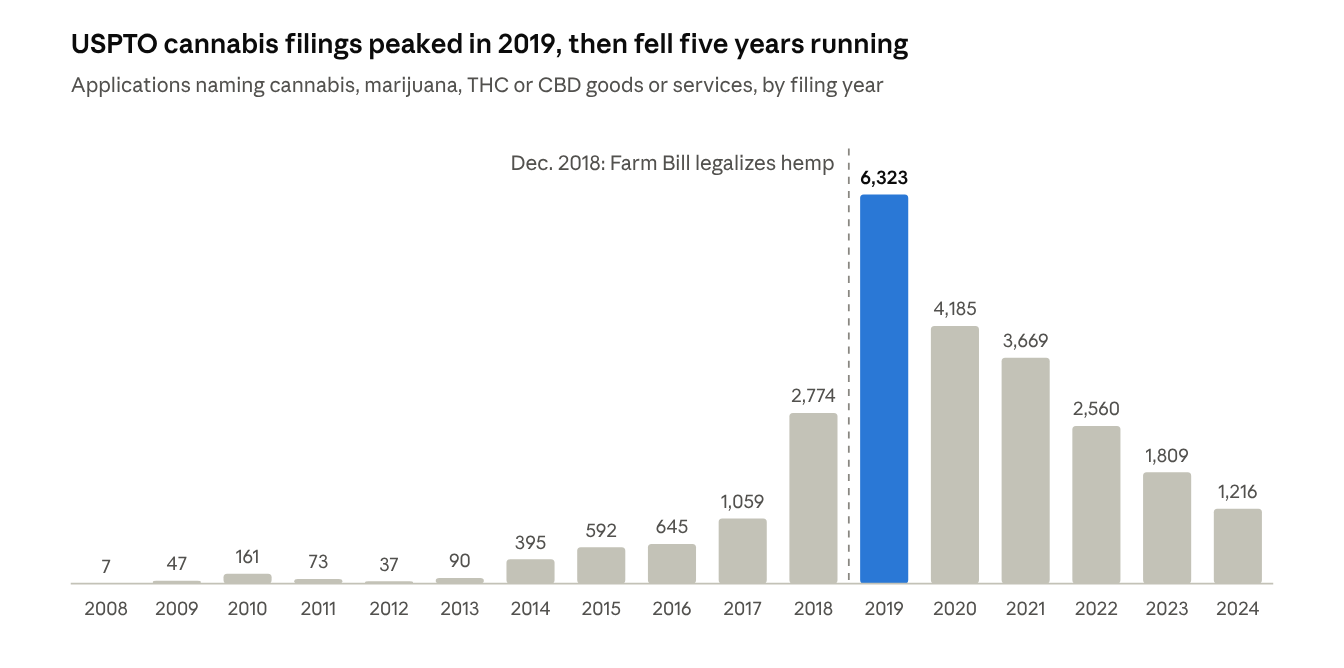
No state publishes counts of its cannabis trademark filings, so the only year-by-year figures available are federal. According to a study by a former USPTO examining attorney, filings rose with each sign of federal acceptance, peaked the year after the Farm Bill, and then declined as refusals continued . Counts are applications whose identifications mention cannabis terms, including some that disclaim cannabis. Figures for 2025 and 2026, including any post-rescheduling rise, have not been published.
The Hemp Redefinition Takes Effect November 12, 2026
The hemp pathway that cannabis brands have relied on since 2019 narrows in three weeks. The appropriations law President Trump signed on November 12, 2025 redefines hemp using a total-THC test rather than delta-9 THC alone, and excludes cannabinoids that are synthesized or converted rather than naturally produced. The change takes effect November 12, 2026. Most intoxicating hemp products, including delta-8, THCA flower and HHC, will fall outside the definition. Bills to repeal or delay the change have been introduced but not enacted.
This matters for trademarks in three ways:
- Identification language goes stale. Many registrations and pending applications recite goods “containing not more than 0.3% delta-9 THC on a dry weight basis.” After November 12, that phrase no longer describes lawful hemp on its own.
- Specimens and continued use. A mark used only on products that become non-compliant may face lawful-use challenges at renewal, in Section 8 declarations, or in TTAB cancellation and opposition proceedings.
- No categorical cancellation, yet. The USPTO has not announced any program to cancel existing hemp registrations because of the redefinition, and Guide 1-19 has not been updated.
The FDCA remains a separate barrier. Under Guide 1-19, the Office still refuses CBD or hemp-derived ingredients in foods, beverages, dietary supplements and pet treats, because those products are not lawful under the FDCA, even when the hemp itself is lawful. Rescheduling did not change that.
State Trademark Registrations for Recreational Cannabis
If your brand sells adult-use cannabis, a state registration in each state where you sell is the only trademark registration currently available for those goods. As of October 2026, 24 states and the District of Columbia have legalized adult-use cannabis. State trademark statutes generally ask whether the mark is lawfully used in that state, not whether the goods are lawful under federal law, so many legal-market states register marks for cannabis flower, concentrates, edibles and dispensary services. California, for example, has accepted cannabis applications since January 1, 2018, provided the products are lawfully in commerce under California law.
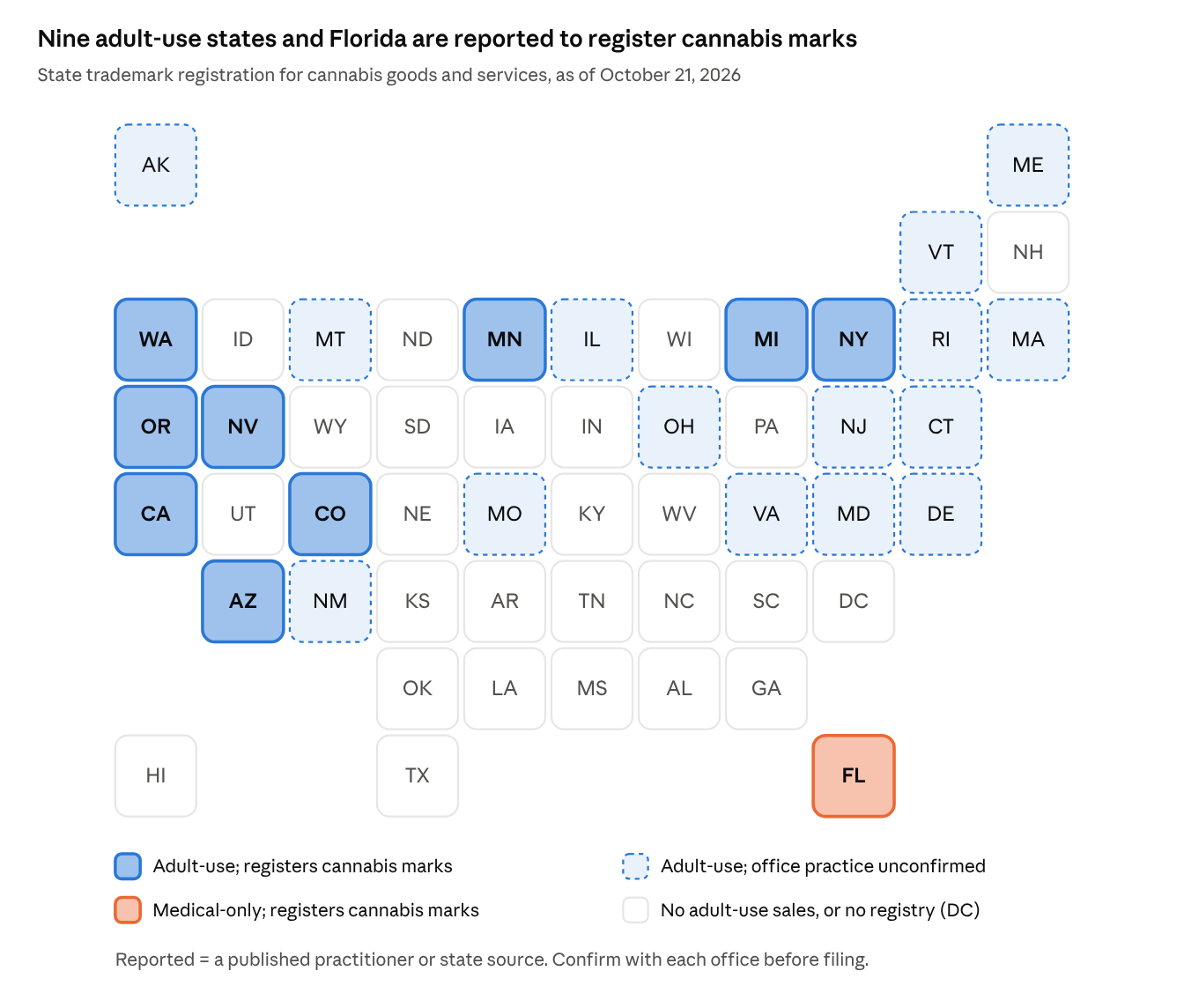
The West Coast, Nevada, Arizona, Colorado, Minnesota, Michigan and New York are reported to register cannabis marks; most other adult-use states have no published policy either way.
| Jurisdiction | Adult-use status (Oct. 2026) | State registration of cannabis marks |
|---|---|---|
| Alaska | Legal, retail open | Verify with state office |
| Arizona | Legal, retail open | Available; first in-state use date required |
| California | Legal, retail open | Available since Jan. 1, 2018; use-based only |
| Colorado | Legal, retail open | Available |
| Connecticut | Legal, retail open | Verify with state office |
| Delaware | Legal, retail open | Verify with state office |
| District of Columbia | Possession legal; no commercial sales | No local trademark registry; rely on federal ancillary filings and common law |
| Illinois | Legal, retail open | Verify with state office |
| Maine | Legal, retail open | Verify with state office |
| Maryland | Legal, retail open | Verify with state office |
| Massachusetts | Legal, retail open | Verify with state office |
| Michigan | Legal, retail open | Available |
| Minnesota | Legal, retail open | Available (reported by Fennemore) |
| Missouri | Legal, retail open | Verify with state office |
| Montana | Legal, retail open | Verify with state office |
| Nevada | Legal, retail open | Available |
| New Jersey | Legal, retail open | Verify with state office |
| New Mexico | Legal, retail open | Verify with state office |
| New York | Legal, retail open | Recommended by practitioners for licensed products |
| Ohio | Legal, retail open | Verify with state office |
| Oregon | Legal, retail open | Available |
| Rhode Island | Legal, retail open | Verify with state office |
| Vermont | Legal, retail open | Verify with state office |
| Virginia | Legal; licensed retail not yet operating | Use-based filing difficult until lawful sales begin |
| Washington | Legal, retail open | Available |
“Verify with state office” means we found no current published confirmation of that office’s practice. Office policies change and are often unwritten, so confirm before filing.
How state registrations differ from federal ones.
- Use first. States have no intent-to-use filing. You must already be selling in that state, and you must give the date of first in-state use.
- In-state only. Protection stops at the state line. A multi-state operator needs a separate registration in each market.
- Classification follows the USPTO. Most states, including California, use the federal Nice classes, so cannabis goods are typically filed in Classes 5, 31 or 34 and dispensary services in Class 35.
- Faster and cheaper, but weaker. State filings cost far less and register quickly. They do not give nationwide priority or constructive notice, and a later federal registrant may still prevail outside your state.
Florida. Florida is medical-only. The 2026 adult-use amendment backed by Smart & Safe Florida failed to qualify for the November ballot, falling roughly 100,000 valid signatures short of the 880,062 required ). Florida’s Registration and Protection of Trademarks Act lets any person who uses a mark in Florida apply to the Department of State. Practitioners at Fennemore report that Florida registers trademarks for cannabis goods and services, so licensed medical marijuana treatment centers should consider a Florida registration and confirm the Department’s current practice before filing. Because Florida medical marijuana now sits in Schedule III, Florida licensees are also among the operators best positioned to test the new federal pathway.
Ten Strategies for Registering Cannabis Brands at the USPTO
- Clear the mark before you commit. Search the federal register, every state register where you sell, and common-law use in dispensary menus, social media and state licensing databases. Cannabis brands often have years of unregistered use behind them, and the earliest user in a market can block you even without a registration.
- Choose a distinctive mark, not a descriptive or drug-referencing one. Strain-style names, slang and terms like “kush,” “OG” or “420” are frequently descriptive, crowded or both. A coined or arbitrary word registers more easily, survives scrutiny longer, and transfers cleanly to ancillary goods and to whatever product categories become lawful later.
- File now for the ancillary goods and services you can register. Federal registration is available today for apparel (Class 25), smoking accessories that are not drug paraphernalia under federal law (Class 34), educational and entertainment services (Class 41), online information and review services (Classes 35 and 42), software and apps (Class 9), and branded merchandise. These filings establish nationwide priority in the mark itself and give you a federal registration to enforce against copycats.
- For medical marijuana, file a clean Schedule III test application. If you hold a state medical license and DEA registration, consider an application limited to medical marijuana goods or dispensing services “provided under a state medical marijuana license and in compliance with the Controlled Substances Act.” Keep adult-use goods out of it entirely, and be ready to document both licenses. Expect office actions or suspension; the filing date may still prove valuable.
- Write identifications that exclude unlawful goods on their face. Examiners refuse based on the identification. Use express limitations: “none of the foregoing containing marijuana or THC in excess of the federal definition of hemp,” or for CBD topicals, compliance language tied to the current statutory hemp definition. After November 12, 2026, replace delta-9-only language with total-THC language that matches the amended definition.
- Keep specimens and marketing consistent with the identification. A clean identification fails if the specimen, website or social posts show the mark on adult-use flower or THC edibles. Examiners routinely review an applicant’s website. Use separate pages, packaging or sub-brands for federally registrable products.
- Use intent-to-use filings strategically. A Section 1(b) application can secure priority for goods that are lawful now, such as hemp topicals or Schedule III medical products, before you launch nationally. Do not file intent-to-use applications for goods you could only sell unlawfully; the TTAB has held that an applicant cannot have a bona fide intent to make unlawful use.
- Layer state registrations, common-law evidence and copyright. For adult-use goods, register in every legal state where you sell. Document first use in each state with dated invoices, menus and photographs. Register logos and packaging artwork with the Copyright Office, which has no lawful-use requirement. Together, these assets fill the gap until federal law catches up.
- Audit your portfolio before November 12, 2026. Review every pending hemp and CBD application and every registration approaching a Section 8 or renewal deadline. Amend identifications where the Office permits, confirm that current specimens show compliant products, and consider new filings with updated language where amendment is not possible.
- Monitor, enforce and plan for the next change. Set watch notices for your marks at the USPTO and in key states. Track the D.C. Circuit challenge, the stayed DEA hearing and any new USPTO examination guide. If adult-use marijuana is rescheduled, the brands with prior ancillary registrations, clean records of use and well-drafted pending applications will be first in line.
The Bottom Line
The 2026 rescheduling did not make cannabis brands federally registrable across the board, but it moved the line for the first time in decades. Medical marijuana operators with state licenses and DEA registration now have a serious argument at the USPTO. Recreational brands still depend on state registrations, ancillary federal filings and careful records of use. Hemp and CBD brands face a hard deadline on November 12, 2026.
The brands that come out ahead will be the ones that file early, draft precisely and keep their portfolios clean while the law settles. If you are building or protecting a cannabis, hemp or CBD brand in Florida or nationally, contact our office to review your portfolio and filing strategy.
Are you interested in seeking trademark and/or trade dress protection for your cannabis related brand? Contact us at [email protected] or call 305-374-8303 to address available state and Federal registration options.
This article is general information, not legal advice, and may not reflect the most recent legal developments. Reading it or contacting us does not create an attorney-client relationship. The hiring of a lawyer is an important decision that should not be based solely upon advertisements.